Decionis

How it works

Every payment, change or API call is decided before it commits.

Your agent or system proposes an action. Your policy decides whether it runs, waits for the person you name, or stops. You get a single-use permit and a signed record for that exact action, and the same action against the same policy always gets the same answer.

What is Execution Authority?

Execution Authority answers one question before an action commits: may this exact action run now, under your policy and the approvals it requires? Your identity system proves who is acting and your guardrails judge content and risk. Execution Authority decides whether the resulting payment, change or API call may commit, and leaves a signed record you can verify.

  • Your policy decides on the exact action, as it stands now.
  • Any approval it requires is bound to that one action.
  • A single-use permit is checked before the action commits.
  • You keep signed evidence of the decision and what happened.
Inspect the authorization and execution sequence

Your identity system, guardrails and downstream application retain their existing responsibilities.

Where the check sits

At the point where the action would commit, in the system that runs it. Your systems keep running the actions.

AgentSafe · Production

In front of your agents' API calls

The gateway checks every write before it is sent. It goes through once, waits for your approval, or is refused.

Commerce Gate · Production

At checkout and on marketplace orders

Walmart, Shopify, WooCommerce and Adobe Commerce: the discount, order or refund that breaks your margin rules is stopped or held.

Govern · Production

Before a deploy reaches production

The GitHub Action checks the change in your pipeline, in shadow first, before it merges or ships.

API and MCP server · Production

Inside your own code

One call before the action you want protected. Your code runs it only on an allow, and keeps the signed record.

Business Central · Private beta

Before a payment posts

A permit bound to the exact payment line, so an approval can't be moved to another vendor or amount.

Every integration and its status: Integrations.

What happens in one decision

The Protocol — Deterministic. Contextual. Explainable.Four stages left to right. Input signals — user or agent identity, context and data, tools and resources, spend and budget, policies, history and reputation, and environment — enter the Decionis Protocol. Inside, the protocol normalizes context and intent, evaluates policies and rules, runs a deterministic risk and policy engine, and explains the reason and evidence. It emits a verdict: ALLOW (authorized), ESCALATE (needs approval or more info), or BLOCK (high risk or out of policy). The verdict drives an enforcement action: allow, block, require approval, or throttle and limit. Every decision is recorded for audit, learning, and continuous improvement.INPUT SIGNALSUser / Agent IdentityContext & DataTools / ResourcesSpend / BudgetPoliciesHistory & ReputationEnvironmentDECIONIS PROTOCOLNormalizeContext & IntentEvaluatePolicies & RulesRisk & Policy Engine(Deterministic)ExplainReason & EvidenceVERDICTALLOWAuthorizedESCALATENeeds approvalor more infoBLOCKHigh risk orout of policyACTIONSAllowBlockRequire ApprovalThrottle / Limit
Four stages left to right. Input signals — user or agent identity, context and data, tools and resources, spend and budget, policies, history and reputation, and environment — enter the Decionis Protocol. Inside, the protocol normalizes context and intent, evaluates policies and rules, runs a deterministic risk and policy engine, and explains the reason and evidence. It emits a verdict: ALLOW (authorized), ESCALATE (needs approval or more info), or BLOCK (high risk or out of policy). The verdict drives an enforcement action: allow, block, require approval, or throttle and limit. Every decision is recorded for audit, learning, and continuous improvement.
Every decision is recorded for audit, learning, and continuous improvement.

Stage 1

Signals

The proposed action plus the evidence around it — actor, amount, counterparty, cost basis, inventory, prior decisions — normalized into one contract regardless of which surface it arrived from.

Stage 2

Policy

The rules in force at that instant, resolved from the policy graph and pinned by version, bundle hash and effective window so the decision is reproducible later.

Stage 3

Verdict

A deterministic ALLOW, ESCALATE or BLOCK — the same signals against the same policy always produce the same verdict.

Stage 4

Action

Execution proceeds, halts, or waits on an approver, and the signed Decision Dossier is written to the ledger either way.

Three answers

The answer is the judgement. What happens next depends on where the check sits: the same answer holds a checkout, an ERP posting or an agent's tool call in the way that system allows.

ALLOW

Authorized

The action is within policy on the evidence presented. It executes, and the dossier records the authority it executed under.

ESCALATE

Needs approval or more info

The action needs authority the requester does not hold, or evidence the request did not carry. It waits for whoever can supply it. When that is a person's approval, Presence, the escalation layer built into Decionis, verifies the approver for this exact action.

BLOCK

High risk or out of policy

The action breaches policy or crosses a risk threshold. It does not execute, and the dossier records which rule stopped it and on what evidence.

What the system you connect can do with an answer

  • Allow
  • Block
  • Require Approval
  • Throttle / Limit

Three things make it authority, not advice

It covers the exact action

A decision covers one action: its target, amount, actor and the policy in force at that moment. Change the action and it needs a new decision.

Your approval travels with it

When your policy says a person decides, that approval is bound to the one action and carried into execution, not left in a chat thread.

Every answer leaves proof

Each decision is signed, so you, your auditor or your bank can check what was permitted, under which rule and whose approval.

Three boxes, not two

Identity proves who. Guardrails judge content. Authority decides the action.

Most teams evaluate with two categories in mind and assume the action is covered. The third box answers a question neither of the others asks — and it treats both of them as inputs.

Necessary. Not sufficient.

Identity and access

Who is acting, and what may it reach?

What it answers
Authenticates the person or the agent, issues and rotates its credentials, and decides what it may reach in general — roles, scopes, tokens, and the delegation chain from a human to the agent acting for them.
What it cannot answer
Whether the action in front of it should happen. A correctly logged-in agent with the right role can still stack discounts below cost, and a valid token can still spend past the budget it was granted under.
What it hands to Decionis
The principal, its delegation and its scopes — the inputs the authority check reads, from the identity layer you already run. Nothing here is replaced.

Examples: Okta · Microsoft Entra · Auth0 · WorkOS

Decionis vs identity and access management
Necessary. Not sufficient.

Guardrails and AI security

Is this input or output unsafe, hostile, or out of policy?

What it answers
Filters prompts and responses, detects injection, leakage and anomalous behaviour, and scores the risk of what a model is about to say or has just said — inside the AI layer, in real time.
What it cannot answer
Whether the resulting action may execute, or who approved it. An agent can reach the same tool from outside the guardrail, and a perfectly clean output can still be a purchase nobody authorised.
What it hands to Decionis
Risk and intent signals, as evidence inside the evaluation. A guardrail verdict is a fact the policy reads; it is not the decision, and it leaves no record a counterparty can check.

Examples: Guardrails AI · Check Point (Lakera) · F5 AI Guardrails · Amazon Bedrock Guardrails · NVIDIA NeMo Guardrails

Decionis vs model guardrails
The third box

Execution Authority

May this exact action execute, now, under whose approval — and can that be proven afterwards?

What it answers
Evaluates the proposed action against the organisation's own policy before it commits, holds it for a named person when the rules require one, and signs a record of what was permitted that someone who does not run Decionis can re-derive.
What it cannot answer
Who the actor is, or whether a prompt was hostile — it consumes both from the boxes beside it. It is the organisation's instrument for the organisation's policy, not an arbiter between the organisation and its counterparties.
What it hands on
A signed Decision Dossier and an execution grant bound to the exact action — what the downstream system executes, and what an auditor, a bank or a buyer verifies against a published key.

Decionis

The category, in full
Identity and guardrails are inputs to authority, not rivals to it. You keep both: the authority check sits above your identity layer and beside your guardrails, not instead of either.

Decision intelligence determines what an AI wants to do. Execution authority determines whether it is permitted to happen. As AI gets faster and more autonomous, identity becomes a weaker proxy for authority.

The map folds the seven-layer control stack into three questions. One layer belongs to no box: execution itself — the downstream system’s commit — is what all three exist to govern.

The map on one page, to print or send →

Seven questions, one control stack

Every layer you already run stays. They answer different questions and pass evidence forward; none of them decides whether this action may commit.

Identity
Who is acting?
Access (IAM)
What may they reach, in general?
Semantic security
What risk or intent signals were observed?
Execution authority
May this specific action execute, now, and under whose approval?
Human authority
Did the required person approve this exact action?
Execution
What did the downstream system commit?
Verifiable evidence
Can an independent verifier prove the chain?

What it doesn't replace

Not an identity system

Identity proves who is acting and IAM decides what they may reach. A correctly logged-in agent with the right role can still stack discounts below cost. You keep your identity layer; it becomes an input.

Compare

Not model guardrails

Guardrails shape what a model says. They don't decide whether the resulting action may execute, and an agent can reach the same tool from outside them.

Compare

Not a policy engine

A policy engine answers when asked and hands the answer back. Here the action can't proceed without the answer, a person is pulled in when your rules require one, and the result is signed.

Compare

Not an orchestration framework

Your orchestrator runs the agent and carries the pause where a person approves. It doesn't decide whether the action needs a person, or whose approval counts.

Compare

Not alerting

An alert tells you what already happened, after the money moved. The check runs before the action commits.

Compare

Every comparison: Compare governance controls.

Your policy, drafted from your own history

You don't start from a blank page. Your own records are checked, a policy is drafted from what was found, and nothing goes live until a person you name approves it.

Walmart: Beta · Business Central: Private beta

Drafted from what happened

Your last 90 days are checked, and each limit in the draft cites the findings behind it. The same findings always give the same draft; no language model writes it.

Before anything goes live

Replayed on your own records

The draft runs against the same records, so you see which actions it would have held, allowed or stopped. Nothing is sent or executed.

Your team: Production · Managed: Private beta

Approved by a person you name

Run it with your own team, where a second person approves every change and the author never can. Or have it managed for you and give the one approval that releases it; any edit you make hands it back to your team.

Every release is signed, so you can always tell which version decided an action and who approved it. Prefer to start elsewhere? Begin from a policy pack, or write your own.

Around one decision

One decision is a single call. Around it sit the policy that was in force, the person who approved, the action that ran, and the signed record that outlives it.

The Decision Lifecycle — From intent to accountable execution.Five stages in a closed loop around the Decionis Protocol. One: Detect, an actor wants to act. Two: Evaluate, apply policies, context and rules. Three: Decide, returning allow, escalate, or block. Four: Execute, carry out the authorized action. Five: Record, log, audit, learn and improve — which feeds back into detection. Every step is observable, explainable, and auditable.1. DETECTto act2. EVALUATEApply policies,context & rules3. DECIDEProceed, Hold,or Escalate4. EXECUTECarry out theauthorized action5. RECORDLog, audit, learnand improveDecionisProtocol
Five stages in a closed loop around the Decionis Protocol. One: Detect, an actor wants to act. Two: Evaluate, apply policies, context and rules. Three: Decide, returning allow, escalate, or block. Four: Execute, carry out the authorized action. Five: Record, log, audit, learn and improve — which feeds back into detection. Every step is observable, explainable, and auditable.
Every step is observable, explainable, and auditable.
  1. 1

    Detect

    A high-stakes action is proposed on some surface.

  2. 2

    Evaluate

    Signals are gathered and checked against the policy in force.

  3. 3

    Decide

    A deterministic verdict is issued — allow, escalate, or block.

  4. 4

    Execute

    The action proceeds, waits for authority, or is stopped.

  5. 5

    Record

    A signed Decision Dossier preserves what was decided and why.

Want to see it refuse something? Run a live decision with no account.

Reference diagrams

The diagrams behind this page, each downloadable as SVG. Reuse them in your own architecture reviews.

The Decionis Thesis

Decionis decides what has authority to happen.

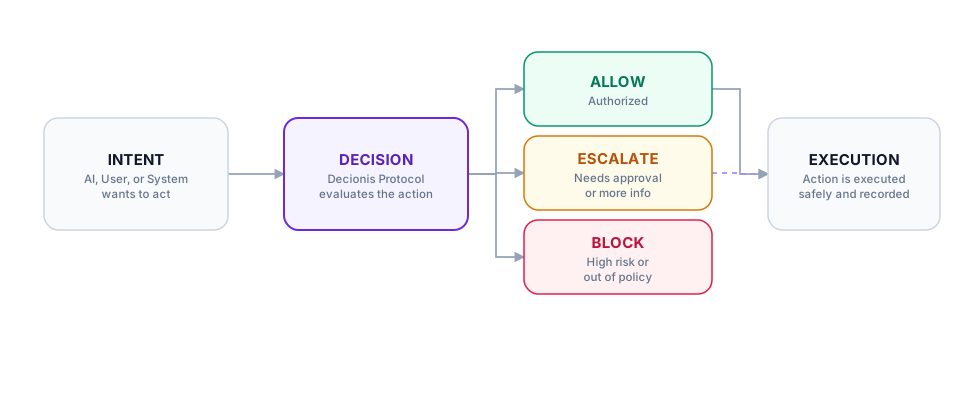
The Decionis Thesis — Decionis decides what has authority to happen.An intent — from an AI, a user, or a system that wants to act — reaches Decision, where the Decionis Protocol evaluates the action. The evaluation returns one of three verdicts: ALLOW, meaning authorized; ESCALATE, meaning it needs approval or more information and is routed to whoever holds the authority; or BLOCK, meaning it is high risk or out of policy. An allowed action reaches Execution, where it is executed safely and recorded; an escalated action reaches it only once approved; a blocked action never does. Decionis is the neutral execution authority between intent and execution.INTENTAI, User, or Systemwants to actDECISIONDecionis Protocolevaluates the actionALLOWAuthorizedESCALATENeeds approvalor more infoBLOCKHigh risk orout of policyEXECUTIONAction is executedsafely and recorded
An intent — from an AI, a user, or a system that wants to act — reaches Decision, where the Decionis Protocol evaluates the action. The evaluation returns one of three verdicts: ALLOW, meaning authorized; ESCALATE, meaning it needs approval or more information and is routed to whoever holds the authority; or BLOCK, meaning it is high risk or out of policy. An allowed action reaches Execution, where it is executed safely and recorded; an escalated action reaches it only once approved; a blocked action never does. Decionis is the neutral execution authority between intent and execution.
The neutral execution authority between intent and execution.

Download SVG — reuse this diagram in decks, docs, and READMEs.

The Surfaces

One Protocol. Many ways to interact.

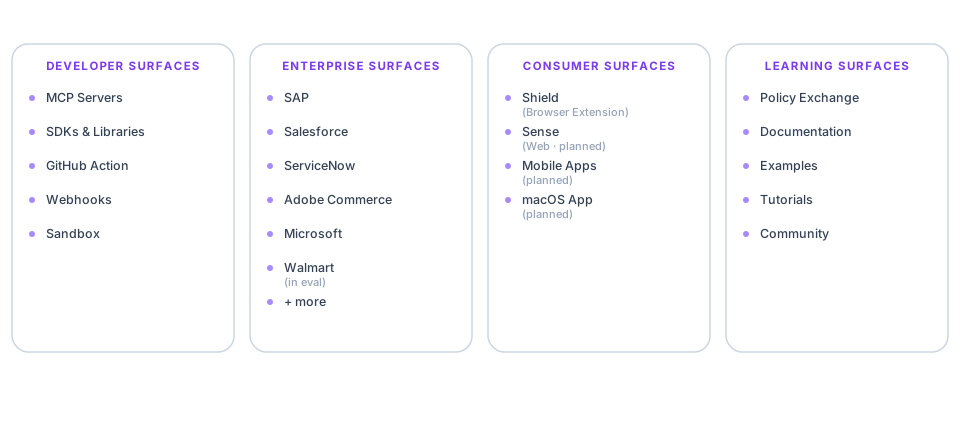
The Surfaces — One Protocol. Many ways to interact.Four columns of surface, all reaching one protocol. Developer surfaces: MCP servers, SDKs and libraries, the GitHub Action, webhooks, and the sandbox. Enterprise surfaces: SAP, Salesforce, ServiceNow, Adobe Commerce, Microsoft, Walmart (in evaluation), and more. Consumer surfaces: Shield as a browser extension, Sense on the web, and mobile and macOS apps planned. Learning surfaces: the Policy Exchange, documentation, examples, tutorials, and community. There are not twenty-five products; there are four families.DEVELOPER SURFACESMCP ServersSDKs & LibrariesGitHub ActionWebhooksSandboxENTERPRISE SURFACESSAPSalesforceServiceNowAdobe CommerceMicrosoftWalmart(in eval)+ moreCONSUMER SURFACESShield(Browser Extension)Sense(Web)Mobile Apps(planned)macOS App(planned)LEARNING SURFACESPolicy ExchangeDocumentationExamplesTutorialsCommunity
Four columns of surface, all reaching one protocol. Developer surfaces: MCP servers, SDKs and libraries, the GitHub Action, webhooks, and the sandbox. Enterprise surfaces: SAP, Salesforce, ServiceNow, Adobe Commerce, Microsoft, Walmart (in evaluation), and more. Consumer surfaces: Shield as a browser extension, Sense on the web, and mobile and macOS apps planned. Learning surfaces: the Policy Exchange, documentation, examples, tutorials, and community. There are not twenty-five products; there are four families.
Not twenty-five products — four families.

Download SVG — reuse this diagram in decks, docs, and READMEs.

The Network

A hosted protocol. Globally available.

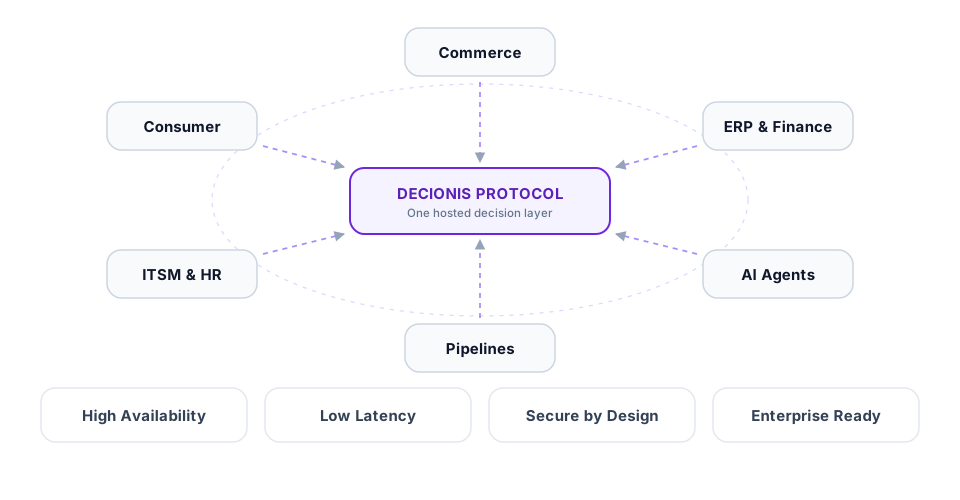
The Network — A hosted protocol. Globally available.One hosted Decionis Protocol at the centre, with surfaces orbiting it: commerce, ERP and finance, AI agents, pipelines, ITSM and HR, and consumer. Each reaches the same protocol, so authority is defined once and enforced everywhere rather than re-implemented per system. The hosted layer is highly available, low latency, secure by design, and enterprise ready. Decionis is a neutral layer across clouds, regions, and systems.DECIONIS PROTOCOLOne hosted decision layerCommerceERP & FinanceAI AgentsPipelinesITSM & HRConsumerHigh AvailabilityLow LatencySecure by DesignEnterprise Ready
One hosted Decionis Protocol at the centre, with surfaces orbiting it: commerce, ERP and finance, AI agents, pipelines, ITSM and HR, and consumer. Each reaches the same protocol, so authority is defined once and enforced everywhere rather than re-implemented per system. The hosted layer is highly available, low latency, secure by design, and enterprise ready. Decionis is a neutral layer across clouds, regions, and systems.
Decionis is a neutral layer across clouds, regions, and systems.

Download SVG — reuse this diagram in decks, docs, and READMEs.

The Ecosystem

Decionis sits between intelligent intent and real-world systems.

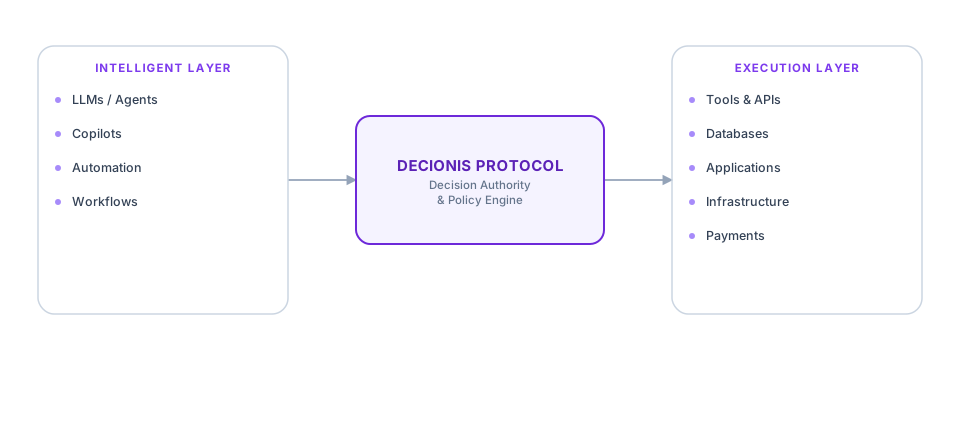
The Ecosystem — Decionis sits between intelligent intent and real-world systems.Three layers left to right. The intelligent layer contains LLMs and agents, copilots, automation, and workflows. Everything it proposes passes through the Decionis Protocol, the execution authority and policy engine. Only then does it reach the execution layer: tools and APIs, databases, applications, infrastructure, and payments. Decionis does not replace the model, the tool, or the system — it is the authority check between the intent and the effect. Any agent, any tool, any system, one consistent decision before anything happens.INTELLIGENT LAYERLLMs / AgentsCopilotsAutomationWorkflowsDECIONIS PROTOCOLExecution Authority& Policy EngineEXECUTION LAYERTools & APIsDatabasesApplicationsInfrastructurePayments
Three layers left to right. The intelligent layer contains LLMs and agents, copilots, automation, and workflows. Everything it proposes passes through the Decionis Protocol, the execution authority and policy engine. Only then does it reach the execution layer: tools and APIs, databases, applications, infrastructure, and payments. Decionis does not replace the model, the tool, or the system — it is the authority check between the intent and the effect. Any agent, any tool, any system, one consistent decision before anything happens.
Any agent. Any tool. Any system. One consistent decision before anything happens.

Download SVG — reuse this diagram in decks, docs, and READMEs.

The Proof

Open, verifiable, and developer-friendly.

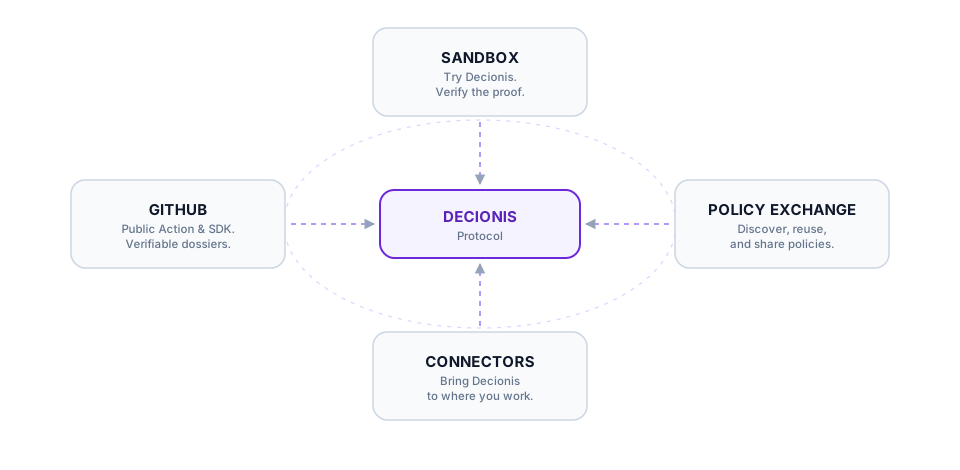
The Proof — Open, verifiable, and developer-friendly.Four forms of evidence orbiting one protocol. The Sandbox: try Decionis, verify the proof. The Policy Exchange: discover, reuse, and share policies. Connectors: bring Decionis to where you work. GitHub: the public govern Action and Node SDK, plus independently verifiable Decision Dossiers. These are not four products in a navigation bar; they are four answers to four different doubts. Transparency builds trust, and proof drives adoption.SANDBOXTry Decionis.Verify the proof.POLICY EXCHANGEDiscover, reuse,and share policies.CONNECTORSBring Decionisto where you work.GITHUBPublic Action & SDK.Verifiable dossiers.DECIONISProtocol
Four forms of evidence orbiting one protocol. The Sandbox: try Decionis, verify the proof. The Policy Exchange: discover, reuse, and share policies. Connectors: bring Decionis to where you work. GitHub: the public govern Action and Node SDK, plus independently verifiable Decision Dossiers. These are not four products in a navigation bar; they are four answers to four different doubts. Transparency builds trust, and proof drives adoption.
Transparency builds trust. Proof drives adoption.

Download SVG — reuse this diagram in decks, docs, and READMEs.

Common questions

How is Execution Authority different from identity and access?

Identity establishes who is acting and access controls which systems they may reach. Execution Authority evaluates whether one exact action may commit under the current policy. A valid credential can still propose an unauthorized action, so action authority binds the parameters, target and required approval to the execution.

Compare the control layers

How is Decionis different from AI guardrails?

AI guardrails catch unsafe prompts, outputs and behavior. They don't decide whether the payment, change or API call that follows may commit. With Decionis, your policy decides that before money moves or a record changes, using the identity, guardrail and operational signals you already have.

Compare governance controls

How is human approval bound to an action?

When policy requires a person, approval is tied to the exact action being evaluated. Presence supplies human-verification evidence, and the execution boundary checks the action’s grant before commitment. An approval for a different action or a grant already claimed does not authorize a new execution.

Verified human approval

What evidence does a decision produce?

A Decision Dossier records the proposed action, policy context and authority verdict with an Ed25519 signature. Where execution is observed, the evidence records that outcome. A verifier can check the signed record independently; a signature proves record integrity, not that every downstream business outcome was successful.

Decision Dossier reference

Updated · Published by Decionis, Inc. · Contact the team